
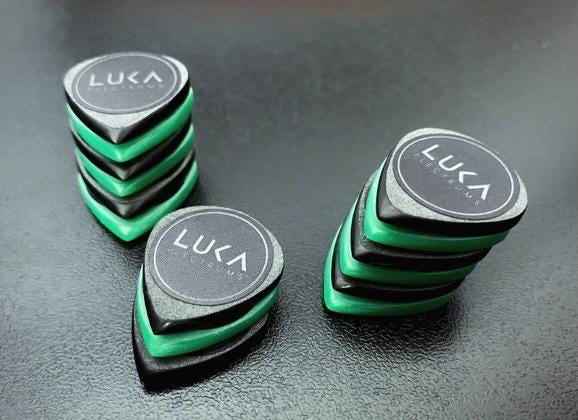
In the world of high-performance polymers, there is one material that makes most makers turn away: UHMWPE (Ultra-High-Molecular-Weight Polyethylene). It is legendary for its durability and its incredibly low friction coefficient—it’s one of the "slickiest" substances known to man.
But for a plectrum maker, it is a nightmare.
The Problem with "The Slickiest Plastic"
Standard abrasive techniques—the kind used by 99% of pick makers—simply don't work on UHMWPE. If you try to sand it or machine it with CNC, the material doesn't "behave." Instead of a clean cut, it "fuzzes" or creates microscopic fibers. The result? A rough, dragging edge that ruins the very thing UHMWPE is famous for: smoothness.
Because of this, many boutique brands avoid it entirely. But at Luka Plectrum, I saw this not as a deterrent, but as an invitation to innovate.
The Breakthrough: Thermal-Polishing
After months of testing, I realized that if I couldn't sand the material to a shine, I had to change its state.
I developed a proprietary Thermal-Polishing Technique. By carefully increasing the surface temperature of the edge during the final shaping stage, I allow the polymer to reach a state of controlled flow. This "melts" the microscopic imperfections away, fusing the fibers into a single, glass-smooth surface.
It is a high-stakes process. A fraction of a second too long, and the geometry of the bevel is ruined. Too short, and the drag remains. But when done right? The result is a plectrum that feels like it’s gliding on air.
Why Play UHMWPE?
If you are a player who hates the "clicky" or "scratchy" noise of standard picks, UHMWPE is your holy grail.
• Zero String Drag: It offers the smoothest release of any material in my workshop.
• Warm, Pure Tone: Because the friction is so low, you hear more of the string and less of the pick.
• Durability: It is virtually indestructible under normal playing conditions.
The Human Element
This is exactly why I stick to my No-CNC philosophy. A machine cannot feel the heat build-up. It cannot see the exact moment the polymer begins to flow. Mastering UHMWPE requires a human hand, a luthier’s eye, and a bit of "alchemical" patience.
Have you experienced the "buttery" attack of a thermally-polished edge?